railroad.wikisort.org - Station
Kyōtango-Ōmiya Station (京丹後大宮駅, Kyōtango-Ōmiya-eki) is a passenger railway station in located in the city of Kyōtango, Kyoto Prefecture, Japan, operated by the private railway company Willer Trains (Kyoto Tango Railway).
Kyōtango-Ōmiya Station 京丹後大宮駅 | |
|---|---|
 Kyōtango-Ōmiya Station, May 2007 | |
| General information | |
| Location | Ōmiya-chō Kuchiōno, Kyōtango-shi, Kyoto-fu 629-2501 Japan |
| Coordinates | 35.5793°N 135.0941°E |
| Operated by |  Kyoto Tango Railway Kyoto Tango Railway |
| Line(s) | ■ Miyazu Line |
| Distance | 42.7 km from Nishi-Maizuru |
| Platforms | 2 side platforms |
| Connections |
|
| Other information | |
| Status | Unstaffed |
| Station code | T18 |
| Website | Official website |
| History | |
| Opened | 3 November 1925 |
| Previous names | Kuchiōno (to 1963) Tango-Ōmiya (to 2015) |
| Passengers | |
| FY2018 | 82 daily |
| Location | |
  Kyōtango-Ōmiya Station Location within Kyoto Prefecture 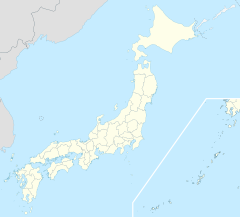 Kyōtango-Ōmiya Station Kyōtango-Ōmiya Station (Japan) | |
Lines
Kyōtango-Ōmiya Station is a station of the Miyazu Line, and is located 42.7 kilometers from the terminus of the line at Nishi-Maizuru Station.
Station layout
The station has two opposed ground-level side platforms connected to the station building by a level crossing. The station is unattended.
Platforms
| 1 | ■ Miyazu Line | for Amino, Kumihama and Toyooka |
| 2 | ■ Miyazu Line | for Amanohashidate and Miyazu |
Adjacent stations
| « | Service | » | ||
|---|---|---|---|---|
| Miyazu Line | ||||
| Yosano | Local | Mineyama | ||
| Yosano | Limited express "Hashidate", "Tango Relay" | Mineyama | ||
History
The station was opened on November 3, 1925 as Kuchiōno Station (口大野駅, Kuchiōno-eki). On May 24, 1963 it was renamed Tango-Ōmiya Station (丹後大宮駅, Tango-Ōmiya-eki) , and renamed again to its present name on March 31, 2015.[1][2]
Passenger statistics
In fiscal 2018, the station was used by an average of 140 passengers daily.[3]
Surrounding area
- Kyotango City Omiya Government Building
- JA Kyoto Omiya Branch
- Ono Castle Ruins
See also
- List of railway stations in Japan
References
- Ishino, Tetsu; et al., eds. (1998). 停車場変遷大事典 国鉄・JR編 [Station Transition Directory – JNR/JR] (in Japanese). Vol. II. Tokyo: JTB Corporation. p. 323. ISBN 4-533-02980-9.
- Willer Group. "経営ビジョン". Retrieved April 4, 2015.
- 京丹後市統計書(令和元年版) [Kyōtango City Statistical Yearbook] (in Japanese). Japan: Kyōtango City. 2019. Retrieved 11 August 2021.
External links

- Official home page (in Japanese)
 | This Kyoto Prefecture railroad station-related article is a stub. You can help Wikipedia by expanding it. |
Другой контент может иметь иную лицензию. Перед использованием материалов сайта WikiSort.org внимательно изучите правила лицензирования конкретных элементов наполнения сайта.
WikiSort.org - проект по пересортировке и дополнению контента Википедии